Showing posts with label Number Talks. Show all posts

Tuesday, 24 February 2015

Number Talks, Take 5!

"Do not give up when things don't go perfectly well; make adjustments and keep moving forward" (p. 31)

And that is just what we plan on doing. We did, however take another break and dropped our Number Talks very readily this past month when our new strategies didn't produce the results we had expected. With report cards due, we all felt pretty justified in focusing our attention elsewhere. But now that they are all done, I finally had the energy to read Chapter 2 of Number Talks to find some fresh ideas. This last tip was at the very end; and yet it is the most important one. Staying positive and persistent when faced with challenges, are necessary qualities if we want to accomplish our goals. And it just so happens that promoting a positive mindset and/or GRIT is a board-wide endeavor this year. Keeping a positive mind set is the only way the students will succeed as well as us teachers.

So last week we restarted our Number Talks with some adjustments. Firstly, we decided it was best to continue to do Number Talks in small groups. This time, we did them first thing in the morning during Tabletop Activity Time when students are most alert. To avoid distractions of other activities at the tables, I brought them into a quiet corner of the room on the carpet and I sat facing outward so I had a view of the rest of the room, while they sat facing me. As Sherry Parrish suggests: "I have found it that it is easier to build a cohesive community and a focused discussion when students shift away from their regular routines and are removed from typical desk distractions" (p. 17). This shift in location, made a huge difference in terms of their attention and engagement. And within one week, students began to await their turn to join in a Number Talk. This past Monday morning I saw one student walk in and wander, so I asked if she wanted to join me for a special activity in the corner. She replied: "I've seen you doing the Number Talks in the corner." I asked if she was excited that it was her turn and she just smiled from ear to ear. Parrish notes: "One way to elevate the status of number talk time and signal its importance is to have a specific location in the classroom where the students gather for this purpose" (p.17). 

Click Here for a blog post on Small Group Number Talks in the Junior Grades
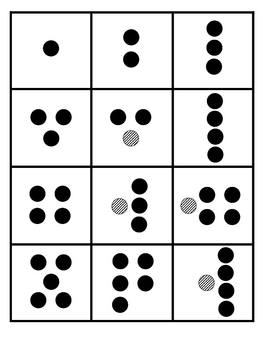
First, I reminded each group of the routine for our Number Talks. First, I would show a card of dots very briefly and then ask them "How many dots do you see?" and "How do you see them?". Then they would place a thumbs up on their chests if they were ready with an answer. I reminded them that it is not important to figure out an answer quickly, but rather that we give everyone a chance to take their time to think and come up with an answer. Since I began teaching, the importance of " wait time" has always been stressed; however this strategy of including a gesture is neat because it makes the wait time obvious to the students themselves. By making "wait time" known to students, they may better understand that speed is not the most important part of success in math. As Sherry Parrish explains: "Many students have the misconception that they are not good at math because they are not fast. We can easily reinforce this misconception if we begin gathering answers as soon as the first students are ready. " (p. 18). Using the procedure of giving a thumbs up is important to "send the message that all students are expected to think and contribute during this time" (Parrish p. 18). 
Set students up for success by grouping them
 by ability and providing tasks at their level.

Next, I explained I would invite those interested in sharing their answer to raise their hands. Keeping the groups small, to a maximum of three students, meant that students were not only more engaged but more comfortable sharing their thoughts. I also made sure to group the students based on similar abilities. Because I kept the groups small (max. 3 children) and carefully selected students with similar needs, all students were eager to share and even the shy ones participated, though they still spoke softly. Parrish also notes that by grouping the students based on their needs, it allows for those that are ready to be challenged (p. 25). I am not yet sure what kind of challenge I will present to those that are stronger but for now I will record their answers and then take the time to analyze them and plan for our second set of small group Number Talks. 

One of Parrish's 5 steps towards teaching for understanding (p. 28) suggests limiting number talk time to a maximum of 5-15 minutes in order to maximize engagement. Back in January, we had decided to review all the cards for number 4, so the Number Talk definitely went on for longer than 5 minutes. Even though it was in a small group,I found even I, myself, was quite bored since it was always the same answer. Although I was recording the answers and analyzing them throughout the Number Talk, this documentation took up way too much time and thus, the students were distracted. So finally I told them, this time our talk would be short so no one would get bored and they could go back to a table activity of their choice after only 5 minutes. Before we began, I set a timer so that we would not get carried away. We were able to get through just 3 cards (one set) with everyone sharing each time. The timer has been ringing just as we are discussing the final card. Limiting the talk to 5 minutes in Kindergarten is a rule I would definitely recommend. 

A few other tips I liked from Chapter 2 (p. 30):

  • Offer a strategy from a previous student 
    • If no one offers a strategy, give an example and ask if it will always work (checking for reliability).
  • It is all right to put a student's strategy on the back burner.
    • If you don't understand a student's strategy and they've already restated it, you can have students turn and talk about what they understand and brainstorm questions to pose for clarification.
    • During this time, listen to students and get a sense if everyone is confused or you can build upon this idea.
    • If not, tell the student you need time to think about it before continuing.
    • This helps keep the conversation pace versus slowing it down and losing students' focus.
I especially like this last phrase because it reassures the student his/her ideas are still valuable and as Parrish says, you can meet later with the student to work through their strategy.

And finally, Parrish's last tip (p.31): 

Possible Next Steps:

  • Use one half PLC day to meet with my colleague from my second class to explain Number Talks and plan to implement them.
  • Read Ch. 3 of Number Talks for more specific strategies in the K-2 classroom to be shared with colleagues.
  • Use my final half PLC day to meet with my first Kindergarten team and discuss possible next steps below.
    • Devise new plans for recording students' thinking so that it can be easily shared with classmates. (Right now we are simply making our own handwritten anecdotal notes to share among the teaching team.)
    • Discuss possible activities/questions Parrish suggested to add to develop more accountability in our Number Talks. (p. 25)
    • Ask students to use finger signals to indicate the most efficient strategy.
    • Require students to solve an exit problem using the discussed strategies. 

Saturday, 10 January 2015

Number Talks - week 3

After reflecting on our first couple weeks of Number Talks, this week we decided to make some changes. First, we thought it would be helpful to try doing them in small groups during table tops to help those that had trouble focusing. This time, I made sure to only briefly show the cards as my teaching partner was already doing so. To refocus on numbers versus pictures we also changed the question from “What do you see?” to “How many dots?”.  Since we started them in November we decided to review the first four strings of cards for the number three. We recorded their answers, and finally, we discussed them.  The results were very interesting.

Since I am the French teacher I was asking them in French "Combien de points?" I recorded their answers in the charts below, noting if they replied in English. We started the Number Talk sitting at a table but I found it distracting and moved the group onto the carpet. Unfortunately I can't recall if we moved for string 2 or string 3.

String 1 – Number 3
Student
Card A
Card B
Card C
Card D
A
1
2
3 (English) I encouraged in French "1, 2, 3"
1, 2, 3
(Counted but card wasn`t in front of her)
B
1
No answer (didn`t see card?)
3 (English)
3 (English)
C
5 (English)
2 (English)
5 (English)
12 (English)
D
No Answer
No answer
(showed 3 fingers)
(showed 3 fingers)


String 2 – Number 3
Student
Card A
Card B
Card C
Card D
A
2
3 fingers
3 (English)
3 (English)
B
2 fingers
3 fingers
3 fingers (encouraged to speak… 3 English)
3
C
2
10 (English)
8 (English)
8 (English)
D
2
No answer
No answer
No answer

I recorded their answers for strings 1 and 2 but found it unnecessary to continue as that was enough data to give us a sense of their thinking. Both Students A & B seem to have a strong sense of the number of dots but still must count from one in French.  found they qucly became unnterested for strngs 3 and 4 as t was not challengng enough so  ased them to show dfferent ways wth ther fngers. Student D was very hesitant and shy to answer but began to hold up three fingers. She may have been inimidated working with the others or speaking in French. I would like to redo the Number Talk on-one-on with Student D. Student C gave random answers and will clearly need extra assistance and practice to develop his number sense. This student`s thinking is revealed below during our discusson.

Here is an account of our conversation after completing the Number Talk:

Teacher: What do you notice about the cards?
Student A: They`re all the same.
Student C: No.
Teacher: How are they the same?
Student A: They`re all sets of 3.
Teacher: Does everyone agree with student A?
Students B & D: Nodded.
Student C: They`re not all the same to me.
Teacher: (Spread out the cards) Look at the cards. How are they different?
Student B: They`re in different ways.
Student C: Different ways.
Teacher: How are they different to you (student D)?
Student C: Mumbled.
Teacher: Asked to repeat but he was shy and needed encouragement.
Studen C: One is down and one is up.

Possible Next Steps:

  • Further discuss with English Partner on Monday to see her results.
  • Continue with small group Number Talks to assess students and make groupings for future learning
  • Read through Kindergarten chapter on Number Talks for more ideas
  • Some possible suggestions from my English partner who was concerned they are just expectng the same answer over and over:
    • move onto number 4
    • Mix the cards up from 1-4


Tuesday, 25 November 2014

Number Talks Week 2 - What exactly is subitizing?

In the last couple weeks of our Number Talks, students have shared many different ideas about how they view the pips (black dots). The goal in my mind at the moment has been primarily to develop a sense of comfort for all students to share their ideas in our classroom and create an encouraging community. At the moment, there is no right or wrong answer since we are simply asking the question “What do you see?”. Beginning with this open-ended question is important so that students understand that everyone visualizes numbers differently.

Last week I found this question invigorated students and I was eager to allow many students a chance to share; but this slowed down the process and students had trouble focusing. This past week I limited the amount to 3 students sharing for each card and this helped us keep our attention. Our students began sharing really wonderful descriptions about the pictures they see within the dots; it was interesting to watch our focus shift from last week with numerical descriptions related to subtraction to creative connects to objects in the real world.

What do you see?

While it is very important to encourage students to think creatively and create this positive atmosphere where students aren't afraid to share their ideas, after our class on Number Sense and having read the article on Subitizing: What is it? Why Teach it?, by Douglas H, Clements, I have a deeper understanding of the goal of our Number Talks. This article reminded me that subitizing means “instantly seeing how many”. I learned that perceptual subitizing means being able to recognize a number without using any mathematical thinking and conceptual subitizing means being able to recognize a number as both the whole and the unit (i.e. You can roll a die and see 2 groups of 3 or one group of 6.)

These skills are important to develop prior to learning more complex addition and subtraction procedures. And as Clements suggests: “Young children may use perceptual subitizing to make units for counting and to build their initial ideas of cardinality.” I had to review the concept of cardinality from the Kindergarten Math Continuum from our school board: “Identify the quantity of items in a collection where the last counting word tells how many (e.g. ‘1, 2, 3, 4… there are 4’)”. Eventually, students begin to conceptually subitize through these counting and patterning abilities and will “discover essential properties of number, such as conservation and compensation… [and] develop such capabilities as unitizing, counting on, and composing and decomposing numbers as well as their understanding of arithmetic and place value” (Clements). Thus, through our Number Talks, our goal is to develop students’ ability to conceptually subitize, laying the foundation for future understanding of strategies for addition and subtraction.

Clements notes specific arrangements of sets that make subitizing easier for children to learn. “Children usually find rectangular arrangements easiest, followed by linear, circular and scrambled”(Clements). It is also important to note he says that preschoolers aged 2-4 cannot conceptually subitize and that for sets of 1-4, no arrangement is easier than any other, but linear is easiest when the set is larger than 4. This means that my 4-year-old kindergarten students are likely to be counting each item but eventually by the end their second year of kindergarten, students will begin to conceptually subitize.

Clements also suggested there are several number activities that will help students develop the ability to subitize. Below are my three favourite activities.

Activity 1
Give each child cards with zero through 10 dots in different arrangements. Have students spread the cards in front of then. Then announce a number. Students find the matching card as fast as possible and hold it up. Have them use different sets of cards, with different arrangements, on different days. Later, hold up a written numeral as their cue. (Clements and Callahan 1986).
Activity 2
Place various arrangements of dots on a large sheet of poster board. With students gathered around you, point out one of the groups as studenst say its number as fast as possible. Hold the poster board in a different orientation each time you play. (Clements 1999).
Activity 3
My kindergartners’ favorite numeral-writing activities involve auditory rhythms. They scatter around the classroom on the floor with individual chalkboards. I walk around the room, then stop and make a number of sounds, such as ringing a bell there times. They write the numeral 3 on their chalkboards and hold them up. (Clements 1999).

After watching recordings of our Number Talks, I realised I have been displaying the dot cards the entire time and allowing lots of time for reflection while my teaching partner has been flashing them briefly.  In order to bring back the focus onto subitizing, “instantly seeing how many”, we will need to change the questions slightly, and ensure we are both presenting the cards briefly.

My Next Steps:
  • Show the cards briefly and then hide them.
  • Change the question from “What do you see?” to “How many dots?”
  • Record their answers.
  • Discuss their answers. If they saw 3, ask “How do you see 3?”
  • Find more Table Top Activities and games specifically related to subitizing

Here is a Subitizing Pinterest Board full of great activities: 


These changes in our Number Talks will help students focus on quantity so their answers should be more numerical. It will also help them realise there is a correct answer when it comes to counting an amount, just as there is a correct way to put together a puzzle, but we may have different strategies for figuring out which pieces go together, some more efficient than others. We will give them a chance to share their methods of visualizing the dots and we can continue to celebrate our differing thought processes, creating a safe atmosphere for all students to share their ideas. The emphasis is not on having the correct answer but uncovering different ways to figure out the puzzle and eventually analyzing which way we feel is most efficient depending on the situation.

References:
Clements, Douglas H. (1999). Subitizing: What Is It? Why Teach It? The National Council of Teachers of Mathematics, Inc. www.nctm.org.
Kindergarten Math Continuum. Teacher Learning and Leadership Program. OCSB.

Saturday, 15 November 2014

Number Talks - Week 1

This week we introduced Number Talks for the first time. It was exciting to see many students with their hands up ready to share their thoughts. Even more exciting, was seeing students that do not often share, raising their hands. 

I was eager to give many students the opportunity to speak, which slowed down my number talk, so I noticed many students started to lose focus until I switched to the next card. Since I was doing the Number Talk in French and students were learning to say “Je vois…” before answering, this also slowed down the process. I debated if it would be better in a small group but ultimately decided I need to limit how many students get to share before moving onto the next card.

This week, we were focusing on learning how to do Number Talks and not on documentation but on my second Number Talk I was eager to start documenting. Since answers were given out so quickly, it would be impossible to document them myself, so l asked my ECE to write down their responses. I showed them 4 different cards with 3 dots arranged in different ways. We noticed many interesting ideas and an interest in subtraction. Here are their responses:

Je vois...

  • 2 dots
  • Take away 1, gets 3, take away is 2
  • Take 3 away, 2, bring back 3 it’s this.
  • Teacher: “Interesting, I like how you used the words take away”.
  • 1, then becomes 2,
    Teacher: “Interesting , you see 1 and then 2.”  I jumped in early here since she continued to speak after me saying: “then becomes 3.”
    Conclusion: She wasn't actually seeing two groups, she was counting.
  •  Then becomes 3.
  • This one is at the bottom half of it. (In reference to 3 dots in a line on the bottom of a square card whereas the other was in the middle.)
  • Take 3 away, no more.
  • 3 same line
  • A diamond. (In reference to a line of 3 dots on a diagonal. I asked her to come and show me the diamond and she turned the square on an angle.)
  • Take one away, will be 2.

Next Steps:

  1. Speed up the number talk by limiting the number of students chosen to share.
  2. The ECE will use the iPad mini to record the Number Talks in both English and French so we can compare them.
  3. Documentation of student thinking through recordings. 


Tuesday, 4 November 2014

Kindergarten Number Talks


This year there is a focus on math in our school board so I decided to take the Primary Math Additional Qualification course. We have been talking about Number Sense in the early years and have had a chance to watch a few videos on communicating our mathematical thinking through something called "Number Talks".
For my inquiry assignment I decided to work with my colleagues and plan to implement these "Number Talks" into our Full-Day Kindergarten program for both English and French days. Today we met to begin planning. I wanted to share our plans in hopes that it might spark an interest among other Kindergarten teachers to check out this great resource and begin their own Number Talks!

Organizing our Number Talks:

Afternoon Table Top Activities (12:40-1:00pm)

o   Provide math games with materials to be presented during Number Talks

§  Ex. Dice, dominos, dot cards, Math books in the library


Afternoon Community Time  (1:00pm-1:15pm)

o   Number Talks – We will start by presenting dot cards and following the progression of cards from the book “Number Talks” by Sherry Parrish.

o   English Talk first, followed by repeating the same talk in French the next day.

Our Number Talk process:


1)    Present the question.

a)    Show a dot card briefly. *Not long enough for them to count the dots. Ask: How many dots do you see?

2)    Invite students to answer and ask: Does anybody else see them a different way?

3)    Students will use hand signals:

a)    Thumbs up means "I have an answer".

b)    Sign language for “the same” means they agree with another student’s answer.

4)    Students must use full sentences.

a)    Ex. "I see…"

b)    Ex. French “Je vois… + English explanation"

5)    Prompt students to explain their thinking and repeat their answers aloud.

a)    How do you see them?

b)    Show me how you found ___.

c)    Tell me what you see. (Ex. I see 4 dots on the bottom and 1 dot on top).
 
Next, our team watched the Number Talks Kindergarten videos and documented the teachers’ questions and prompts. We created a list of language we wish to use during Number Talks with dot cards, 10 frames, Rekenreks, and counting books.

As we begin this inquiry into Number Talks and reflect on their effect on students' mathematical development and ability to communicate their mathematical thinking, I will continue to post our findings in my blog. We will start our Number Talks next week using dot cards and look forward to this new adventure in our classroom!