Tuesday, 25 November 2014

Number Talks Week 2 - What exactly is subitizing?

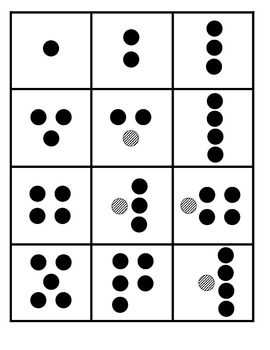
In the last couple weeks of our Number Talks, students have shared many different ideas about how they view the pips (black dots). The goal in my mind at the moment has been primarily to develop a sense of comfort for all students to share their ideas in our classroom and create an encouraging community. At the moment, there is no right or wrong answer since we are simply asking the question “What do you see?”. Beginning with this open-ended question is important so that students understand that everyone visualizes numbers differently.

Last week I found this question invigorated students and I was eager to allow many students a chance to share; but this slowed down the process and students had trouble focusing. This past week I limited the amount to 3 students sharing for each card and this helped us keep our attention. Our students began sharing really wonderful descriptions about the pictures they see within the dots; it was interesting to watch our focus shift from last week with numerical descriptions related to subtraction to creative connects to objects in the real world.

What do you see?

While it is very important to encourage students to think creatively and create this positive atmosphere where students aren't afraid to share their ideas, after our class on Number Sense and having read the article on Subitizing: What is it? Why Teach it?, by Douglas H, Clements, I have a deeper understanding of the goal of our Number Talks. This article reminded me that subitizing means “instantly seeing how many”. I learned that perceptual subitizing means being able to recognize a number without using any mathematical thinking and conceptual subitizing means being able to recognize a number as both the whole and the unit (i.e. You can roll a die and see 2 groups of 3 or one group of 6.)

These skills are important to develop prior to learning more complex addition and subtraction procedures. And as Clements suggests: “Young children may use perceptual subitizing to make units for counting and to build their initial ideas of cardinality.” I had to review the concept of cardinality from the Kindergarten Math Continuum from our school board: “Identify the quantity of items in a collection where the last counting word tells how many (e.g. ‘1, 2, 3, 4… there are 4’)”. Eventually, students begin to conceptually subitize through these counting and patterning abilities and will “discover essential properties of number, such as conservation and compensation… [and] develop such capabilities as unitizing, counting on, and composing and decomposing numbers as well as their understanding of arithmetic and place value” (Clements). Thus, through our Number Talks, our goal is to develop students’ ability to conceptually subitize, laying the foundation for future understanding of strategies for addition and subtraction.

Clements notes specific arrangements of sets that make subitizing easier for children to learn. “Children usually find rectangular arrangements easiest, followed by linear, circular and scrambled”(Clements). It is also important to note he says that preschoolers aged 2-4 cannot conceptually subitize and that for sets of 1-4, no arrangement is easier than any other, but linear is easiest when the set is larger than 4. This means that my 4-year-old kindergarten students are likely to be counting each item but eventually by the end their second year of kindergarten, students will begin to conceptually subitize.

Clements also suggested there are several number activities that will help students develop the ability to subitize. Below are my three favourite activities.

Activity 1
Give each child cards with zero through 10 dots in different arrangements. Have students spread the cards in front of then. Then announce a number. Students find the matching card as fast as possible and hold it up. Have them use different sets of cards, with different arrangements, on different days. Later, hold up a written numeral as their cue. (Clements and Callahan 1986).
Activity 2
Place various arrangements of dots on a large sheet of poster board. With students gathered around you, point out one of the groups as studenst say its number as fast as possible. Hold the poster board in a different orientation each time you play. (Clements 1999).
Activity 3
My kindergartners’ favorite numeral-writing activities involve auditory rhythms. They scatter around the classroom on the floor with individual chalkboards. I walk around the room, then stop and make a number of sounds, such as ringing a bell there times. They write the numeral 3 on their chalkboards and hold them up. (Clements 1999).

After watching recordings of our Number Talks, I realised I have been displaying the dot cards the entire time and allowing lots of time for reflection while my teaching partner has been flashing them briefly.  In order to bring back the focus onto subitizing, “instantly seeing how many”, we will need to change the questions slightly, and ensure we are both presenting the cards briefly.

My Next Steps:
  • Show the cards briefly and then hide them.
  • Change the question from “What do you see?” to “How many dots?”
  • Record their answers.
  • Discuss their answers. If they saw 3, ask “How do you see 3?”
  • Find more Table Top Activities and games specifically related to subitizing

Here is a Subitizing Pinterest Board full of great activities: 


These changes in our Number Talks will help students focus on quantity so their answers should be more numerical. It will also help them realise there is a correct answer when it comes to counting an amount, just as there is a correct way to put together a puzzle, but we may have different strategies for figuring out which pieces go together, some more efficient than others. We will give them a chance to share their methods of visualizing the dots and we can continue to celebrate our differing thought processes, creating a safe atmosphere for all students to share their ideas. The emphasis is not on having the correct answer but uncovering different ways to figure out the puzzle and eventually analyzing which way we feel is most efficient depending on the situation.

References:
Clements, Douglas H. (1999). Subitizing: What Is It? Why Teach It? The National Council of Teachers of Mathematics, Inc. www.nctm.org.
Kindergarten Math Continuum. Teacher Learning and Leadership Program. OCSB.

Saturday, 15 November 2014

Number Talks - Week 1

This week we introduced Number Talks for the first time. It was exciting to see many students with their hands up ready to share their thoughts. Even more exciting, was seeing students that do not often share, raising their hands. 

I was eager to give many students the opportunity to speak, which slowed down my number talk, so I noticed many students started to lose focus until I switched to the next card. Since I was doing the Number Talk in French and students were learning to say “Je vois…” before answering, this also slowed down the process. I debated if it would be better in a small group but ultimately decided I need to limit how many students get to share before moving onto the next card.

This week, we were focusing on learning how to do Number Talks and not on documentation but on my second Number Talk I was eager to start documenting. Since answers were given out so quickly, it would be impossible to document them myself, so l asked my ECE to write down their responses. I showed them 4 different cards with 3 dots arranged in different ways. We noticed many interesting ideas and an interest in subtraction. Here are their responses:

Je vois...

  • 2 dots
  • Take away 1, gets 3, take away is 2
  • Take 3 away, 2, bring back 3 it’s this.
  • Teacher: “Interesting, I like how you used the words take away”.
  • 1, then becomes 2,
    Teacher: “Interesting , you see 1 and then 2.”  I jumped in early here since she continued to speak after me saying: “then becomes 3.”
    Conclusion: She wasn't actually seeing two groups, she was counting.
  •  Then becomes 3.
  • This one is at the bottom half of it. (In reference to 3 dots in a line on the bottom of a square card whereas the other was in the middle.)
  • Take 3 away, no more.
  • 3 same line
  • A diamond. (In reference to a line of 3 dots on a diagonal. I asked her to come and show me the diamond and she turned the square on an angle.)
  • Take one away, will be 2.

Next Steps:

  1. Speed up the number talk by limiting the number of students chosen to share.
  2. The ECE will use the iPad mini to record the Number Talks in both English and French so we can compare them.
  3. Documentation of student thinking through recordings. 


Tuesday, 4 November 2014

Kindergarten Number Talks


This year there is a focus on math in our school board so I decided to take the Primary Math Additional Qualification course. We have been talking about Number Sense in the early years and have had a chance to watch a few videos on communicating our mathematical thinking through something called "Number Talks".
For my inquiry assignment I decided to work with my colleagues and plan to implement these "Number Talks" into our Full-Day Kindergarten program for both English and French days. Today we met to begin planning. I wanted to share our plans in hopes that it might spark an interest among other Kindergarten teachers to check out this great resource and begin their own Number Talks!

Organizing our Number Talks:

Afternoon Table Top Activities (12:40-1:00pm)

o   Provide math games with materials to be presented during Number Talks

§  Ex. Dice, dominos, dot cards, Math books in the library


Afternoon Community Time  (1:00pm-1:15pm)

o   Number Talks – We will start by presenting dot cards and following the progression of cards from the book “Number Talks” by Sherry Parrish.

o   English Talk first, followed by repeating the same talk in French the next day.

Our Number Talk process:


1)    Present the question.

a)    Show a dot card briefly. *Not long enough for them to count the dots. Ask: How many dots do you see?

2)    Invite students to answer and ask: Does anybody else see them a different way?

3)    Students will use hand signals:

a)    Thumbs up means "I have an answer".

b)    Sign language for “the same” means they agree with another student’s answer.

4)    Students must use full sentences.

a)    Ex. "I see…"

b)    Ex. French “Je vois… + English explanation"

5)    Prompt students to explain their thinking and repeat their answers aloud.

a)    How do you see them?

b)    Show me how you found ___.

c)    Tell me what you see. (Ex. I see 4 dots on the bottom and 1 dot on top).
 
Next, our team watched the Number Talks Kindergarten videos and documented the teachers’ questions and prompts. We created a list of language we wish to use during Number Talks with dot cards, 10 frames, Rekenreks, and counting books.

As we begin this inquiry into Number Talks and reflect on their effect on students' mathematical development and ability to communicate their mathematical thinking, I will continue to post our findings in my blog. We will start our Number Talks next week using dot cards and look forward to this new adventure in our classroom!

Friday, 25 July 2014

Oral Communication Development for ALL Students

As a French teacher I primarily considered oral communication skills in respect to teaching and learning a second language; however after a few years in Kindergarten I have realised the importance of modeling basic but very valuable communication skills as simple  as turn taking, active listening, and providing students with opportunities to practice these skills.

In our lesson planning in teacher's college, we were granted permission and even encouraged to "beg, borrow, and steal", thus I have done just that and discovered an amazing website full of literacy lessons and in particular activities to develop oral language and vocabulary.  In Kindergarten one of the first lessons we teach is that we share EVERYTHING, so I am sharing the lesson in this post!  

The Conversation Station is one of my favourite ideas from the website The Balanced Literacy Diet. This would be a really great learning area to set up in the classroom year-round. Below I will list some ways I might personally adapt the activity for ESL students as well as other suggestions and specific program expectations covered.

First, here is the link where you can read the actual lesson plan complete with preparation instructions, adaptations for various kinds of learners, and extension activities:
http://www.oise.utoronto.ca/balancedliteracydiet/Recipe/00160/


Ontario Early Learning Kindergarten Program Expectations

The Big Idea: Children are effective communicators.

Overall Expectation 1: communicate by talking and by listening and speaking to others for a variety of purposes and in a variety of contexts.

The Conversation Station could really fulfill almost all of the oral language goals but I have selected these few to focus on in the beginning. 

1.2 listen and respond to others for a variety of purposes (e.g., to exchange ideas, express feelings, offer opinions) and in a variety of contexts

1.8 ask questions for a variety of purposes (e.g., for obtaining information,) and in different contexts (e.g. During discussions and conversations with peers and adults; before, during, and after read-aloud activities and shared reading; in small groups at learning centres

1.9 describe personal experiences using vocabulary and details appropriate to the situation

Later in the year you could focus on these as well:

1.5 use language in various contexts to connect new experiences with what they already know (e.g., contribute ideas orally during shared or interactive writing; contribute to conversations at learning centres; respond to teacher prompts)

1.7 use specialized vocabulary for a variety of purposes

1.10 orally retell simple events and simple familiar stories in proper sequence

Assessment Suggestions
- Anecdotal notes on students' interests.
- Use a class list to evaluate students' responses had lots of detail, some, or needed prompting.
- Note any speech and language concerns such as pronunciation difficulties.
- Later in the year - teach students to use iPads for recording conversations with each other either video or just audio.

ESL Student Considerations

- Invite ESL students to join the station with a friend so they feel more at ease.
- Encourage the use of lots of gestures.
- Speak slowly and clearly, using short simple sentences.
- Point to pictures as you model speaking.
- Have them use props and point to pictures if they are not ready to speak.
- Ask questions that provide choice of answers within. Ex. Is this mom or dad?
- Use dolls and puppets to have the conversation so they may feel more comfortable taking risks and making mistakes.

September Ideas
Materials: 
- Books about beginning school. 
- Photos of students in various learning areas.
- Books about families showing diversity.
- Photo album of students' family photos.
Implementation:
- Discussion on "good talkers" and "good listeners" should not just be optional.
- Invite students to suggest their own future topics and materials to include.
- Teachers should take time to talk to a few students a day so they can meet with all students within the first couple weeks of school.

Other Suggestions
- Adapt station for French days to include a question of the day to practice.
- Model and include question starters: who, what, where, why, how?
- Speakers Corner - This was a great idea shared by a classmate and is similar to the Conversation Station. A "question of the day" is posted in the corner and two students are chosen per day to interview friends and record their interviews with iPads.

I am very excited to set-up a Conversation Station in my classroom next September and will be sure to write a follow up post to share how students' oral communication skills are developing! 

Resources

The Balanced Literacy Diet. Developed and hosted by: OISE, University of Toronto. 
http://www.oise.utoronto.ca/balancedliteracydiet/Home/index.html

The Ontario Full-Day Early Learning Kindergarten Program

Supporting English Language Learners in Kindergarten


Monday, 14 July 2014

Play-Based Activities for Self-Regulation


One goal of Ontario's Full-Day Early Learning Kindergarten Program is to provide a play-based learning environment for children and rather than pushing for earlier readers, research has proven that self-regulation is the key to future success.  As suggested in this article of the Globe and Mail : EQ over IQ: How play-based learning can lead to more successful kids., bringing play into Kindergarten helps children develop emotional intelligence which, in the long run, leads to more happy, healthy adults.

Firstly, I wondered what exactly self-regulation means. Dr. Charles E. Pascal explains it as "[t]he abilities of children to regulate their own emotions, behaviours, and attention" (Early Learning for Every Child Today, p. 8). I also came across an article by Deborah J. Stewart who states "self-control isn’t about making kids behave, it is about giving children the tools they need to guide their own behavior and as they accomplish this goal, they will be building the tools they need to be positive participants in the classroom experience" (Teach Preschool : Helping young children develop self-control).

As I venture into planning for this play-based environment, I am in search of activities that will promote self-regulation and autonomy while also considering strategies for teaching boys, English-language learners, and students with special needs. Below are three types of activities that should do just that!

Active Games with Rules

These games involve a set of rules and once children learn the rules, the educator may choose a student take the leadership role in calling out a command to other children. This not only promotes autonomy but it also is also gives them a chance to decide right from wrong and take ownership over their behaviour. These play-based activities are engaging and fun and at the same time students are required to practice focusing their attention on instructions and controlling their behaviour. If you aren't familiar with these games, simply click on the title for a link to the instructions with variations and great alternatives to getting "out".

Strategies / Accomodations

  • Using visuals ie. traffic light, flash cards with actions
  • Modeling short commands for "Simon Says"
  • Using gestures for actions and numbers
  • Incorporating music and movement and technology
These are excellent strategies to engage and assist English-language learners in understanding and developing vocabulary in a fun, engaging atmosphere. While these students may not be ready to take a leadership role, they may still participate and feel a part of the group. By providing visuals, assistance in describing actions, or giving choices of simple commands or numbers, this activity may be differentiated for various learners from ESL students, to those with a variety of special needs.

 Complex Dramatic Play

  • Role-playing activities
  • Dramatization of stories
  • Re-enactments of real-life problems with new solutions
  • Create short cartoon clips and record their voices with iPad Apps
Students are guided by teachers in their dramatic play in order to develop their abilities to take on different roles and regulate their behaviours based on their chosen characters. These activities appeal to all different learners as each chooses a role of their own interest and ability. Students are encouraged to express their emotions, solve problems, and plan their play.

Strategies / Accomodations

  • Provide a variety of dramatic play materials that reflect students' backgrounds
    • i.e. inviting parents to donate materials from home 
  • Student-centered - have students lead planning of dramatic play area
    •  i.e. theme,  materials lists
  • Encourage inclusivity: all students regardless of ability may take a role of their choice
  • Avoid gender biases of roles
  • Record students' plays/reenactments to play back and reflect or share with whole class 
 By encouraging parents to send in materials from home, student diversity is valued. Stories and music related to students' backgrounds and in a variety of languages would also allow for English-language learners to celebrate their cultures and provide a rich experience for the whole class.  Pretend-play provides a safe atmosphere for English-language learners to practice using language and develop their comprehension skills.

Sensory, Slow Movement, & Mindfulness Activities


Incorporating a balance of slow movement and mindfulness activities is an integral part of promoting self-regulation as we all need to take time to relax. Teachers also need to provide various sensory activities and independant play-based materials so students may explore and discover their personal preferences.

Strategies / Accomodations

  • Provide a safe-place accessible to any child in need of calming down
  • Guide students to participate in sensory activities a their own pace
  • Help students choose an activity prior to play time so they have a focus
  • Encourage children to talk about their feelings after trying a new activity
  • Take pictures of students expressing different emotions and using calming techniques and place in a book in the safe place

Taking time to be quiet and calm is important for all students and each individual may find different activities calming and soothing. By providing a variety of strategies and materials, educators may encourage all students to become aware of their preferences. Some students with special needs may need more stimulation than others and enjoy sensory bin activities as a way of calming down. Other students may find they prefer listening to calming music. English-language learners have the freedom to explore and play with these materials with no pressure of using language. Teachers should discuss with students what our body looks and feel like when we various emotions. Acting out these emotions helps children recognize them and these play-based activities provide strategies for calming down when necessary. 


Planning time to guide students in theses three play-based types of activities will be a key component to encourage development of their self-regulation and the secret to their future success!


In my research, I came across some excellent articles, websites, and blogs on self-regulation activities. Be sure to check out the resources below.


Resources:

Move With Me Blog
The Ontario Full-Day Early Learning Kindergarten Program
Self-Regulation Games and Exercises
Self-Regulation Skills for Preschoolers
A Sensory Life
Supporting English Language Learners in Kindergarten
Teaching Kids Self-Regulation Through the Practice of Meditation
Tools of the Mind: Self-Regulation
What is the Point of  Sensory Bin?